
Improving Industry with Embedded AI
Januar 22, 2026
Why progress is driven by precision, not scale
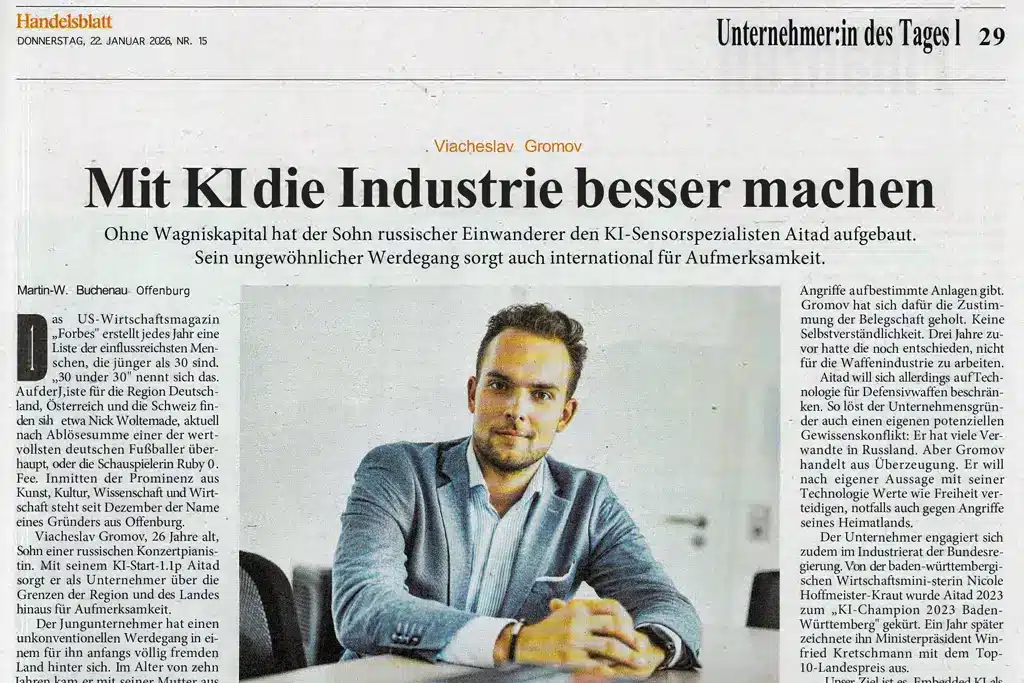
In a recent Handelsblatt profile (in german language), AITAD is described as an example of a technology-driven industrial pioneer that deliberately follows a different path than many AI start-ups: without venture capital, with a clear focus on industrial applications, and with technology designed not for attention, but for impact.
This perspective addresses a core issue in today’s AI debate.
When artificial intelligence is discussed today, the focus often lies on scale: larger models, more data, greater computing power. This mindset dominates the world of generative AI in particular. For industrial applications, however, this logic falls short.
Industry does not improve because AI becomes bigger. It improves when AI is precise, reliable, and effective exactly where real processes take place.
Industrial systems follow different rules than digital platforms. They are safety-critical, physically embedded, time-dependent, and designed for long life cycles. In this context, what matters is not theoretical model performance, but whether decisions are made deterministically, operate independently of external infrastructure, and remain robust under real-world conditions.
This is precisely where AITAD’s embedded AI comes into play. Instead of transferring data to distant data centers for analysis, processing takes place directly within the sensor or device. Decisions are made where the data originates — without detours, without latency, and without unnecessary dependencies. This not only increases reaction speed but also strengthens data sovereignty, energy efficiency, and operational reliability.
As described in the Handelsblatt, this approach is no coincidence, but the result of consistent systems thinking. Industrial progress depends less on model size than on sound architectures — architectures that consider hardware, software, and AI together, integrate security and updateability from the outset, and remain verifiable and maintainable over the long term.
Technology deployment is therefore never purely a technical issue. It is always also a question of responsibility. Which data is processed? Where do dependencies arise? How transparent do decisions remain? Embedded AI forces these questions to be addressed early, because decisions are made locally, context-aware, and traceable.
In the global AI competition, Europe is often measured against the standards of digital platforms. Its real strength, however, lies in industrial intelligence: deep process expertise, highly specialized applications, and the ability to operate complex systems reliably. Embedded AI builds precisely on these strengths.
The path described in the Handelsblatt makes one thing clear: industrial progress is not driven by noise, but by precision — not by abstraction, but by proximity to real processes.
At AITAD, our ambition is therefore not to make AI more visible, but more effective. Because ultimately, what matters is not how impressive a technology sounds, but how well it improves real systems.